Top 10 HRMS Software Companies in India
Picking an HRMS in India isn’t easy right now. Dozens of platforms, all promising the same things, and most demo calls end with you more confused than when you started.
So this list cuts through that.
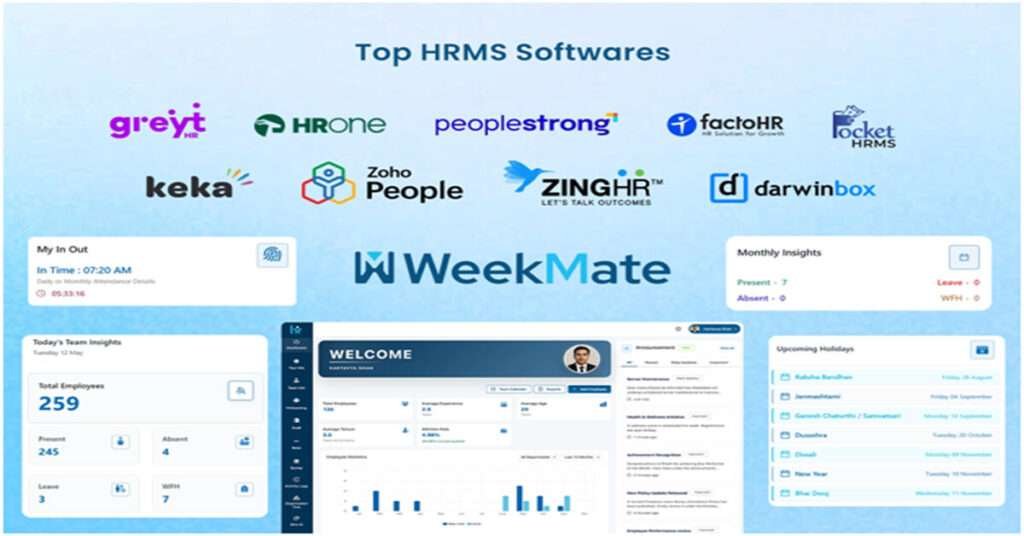
These are 10 HRMS platforms actually worth a look in 2026, ranked by what they do well, where they trip up, and who they fit best. No vendor talking points. Just what HR teams, founders, and operations heads usually need to know before signing.
A quick note before you scroll. The “right” HRMS depends heavily on team size, compliance load, and budget. A 30 person startup needs something very different from a 2000 employee manufacturing unit. Keep that in mind as you read.
For a broader view first, our guide to common HRMS modules and features covers what every modern platform should include. Smaller teams will also find the case for HR management software for small businesses useful.
Alright. Let’s get into it.
1. WeekMate
Best for: SMEs, startups, and growing businesses that want HR, payroll, and operations under one roof without enterprise pricing.
WeekMate has built a reputation as one of the best HRMS software in India for teams that don’t want to juggle five different tools. It rolls HR, payroll, attendance, statutory compliance, CRM, and task management into one suite. Unusual at this price point, frankly.
What stands out:
- Payroll handles PF, ESI, TDS, and the new wage code rules without Excel acrobatics
- GPS based attendance with proper shift management
- Built in CRM and TaskHub, so smaller teams skip extra Salesforce or Asana licenses
- A mobile app employees actually open
Where it could be sharper: analytics dashboards are improving fast but still trail Darwinbox on deep workforce insights. If you’re a 5000+ employee enterprise with complex global reporting needs, look elsewhere.
For midsize Indian businesses, though, WeekMate hits the sweet spot. Pricing is honest, support actually picks up the phone, and onboarding takes days, not months.
2. Darwinbox
Cloud native, enterprise grade, and probably the most polished Indian HRMS on the market today. Darwinbox powers HR for Mahindra, Adani, JSW, and a long list of other large names.
It delivers on mobile first design, AI driven workflows, and deep configurability. Talent management and performance modules are particularly strong.
The catch? Priced for the enterprise. Implementation typically runs 8 to 12 weeks. Smaller teams find it overkill.
If you’re 1000+ employees with a serious budget, shortlist it. Otherwise the ROI rarely works out.
3. Keka HR
A favorite among Indian SaaS and tech companies. Keka nailed user experience early, and that still shows.
Why teams pick it:
- Clean, intuitive interface
- Strong payroll for mid sized firms
- Performance management with OKRs done well
- Solid expense tracking
Where it gets criticized: support response times have been hit or miss according to recent G2 reviews, and customization is more limited than competitors at the same price.
Honestly, Keka is great if you’re a 50 to 500 employee tech company in metro cities. For factories or distributed retail, it feels a bit off.
We’ve done a direct comparison of Keka and our own platform if you’re weighing the two.
4. greytHR
Probably the most established name on this list. greytHR has been around for over two decades and serves more than 30,000 customers across India and the Middle East.
Its claim to fame is payroll and statutory compliance. Indian labour law changes constantly, and greytHR’s team is genuinely good at keeping pace.
But the interface? Looks dated. Some users describe it as functional but unexciting. Leave and attendance modules also feel rigid compared to newer platforms.
A safe choice for traditional Indian businesses, services firms, and compliance heavy organizations. Less exciting if you want a modern, mobile first experience.
Side by side look at greytHR pros and cons.
5. Zoho People
Part of the Zoho ecosystem, which is both the reason to choose it and sometimes the reason to skip it.
If you already run Zoho CRM, Books, or Mail, People plugs in cleanly. That counts for a lot.
Pricing is among the most affordable on this list. The free tier (up to 5 users) is genuinely usable for tiny teams.
What you give up: payroll is available but feels bolted on compared to dedicated payroll engines. For complex Indian compliance scenarios you’ll often need workarounds.
Good fit for early stage startups already living in the Zoho world.
6. PeopleStrong
One of India’s oldest HRMS players, now positioned squarely at the enterprise. PeopleStrong serves Tata, Yes Bank, Wipro, and similar names.
Strong areas: recruitment, learning, and workforce analytics. Their AI assistant Jinie is interesting, though early users say it still has rough edges.
Fits large Indian enterprises that want a homegrown alternative to SAP SuccessFactors or Oracle. The interface isn’t the prettiest.
Pricing is on request, which usually translates to a budget conversation.
7. Pocket HRMS
A dependable choice for small and mid sized Indian businesses, particularly in manufacturing, retail, and distribution.
What works:
- Affordable pricing tiers
- Decent payroll with statutory coverage
- Biometric integration is straightforward
- Customer support gets consistent praise
Where it lags: mobile experience, performance management, and AI driven features. Visually it feels a generation behind Keka or WeekMate.
If you want something dependable and budget friendly for under 200 employees, Pocket HRMS deserves a demo slot.
8. HROne
HROne markets itself as “everything HR in one platform” and mostly delivers on that promise. It covers the full hire to retire lifecycle.
Notable strengths: 127+ predefined HR processes, strong onboarding workflows, and a usable mobile app.
Pricing is module based. Sounds flexible, stacks up quickly once you add the modules most teams actually need.
Best suited for the 200 to 2000 employee range that wants depth without going full enterprise. Detailed HROne comparison here.
9. factoHR
factoHR has carved out a real niche in payroll and statutory compliance, especially for manufacturing, BFSI, and shift heavy operations.
The payroll engine handles edge cases (loans, advances, multi state PF, ESI variations) without custom development. That’s not common in this segment.
What’s missing: modern UX. Dashboards feel like Excel ported to a browser. Talent management is also basic.
If payroll precision sits in your top three priorities, shortlist factoHR. For a more rounded modern experience, compare it side by side.
10. ZingHR
ZingHR positions itself as a global, mobile first HRMS with Indian roots. Used by Bharti Airtel, Vodafone Idea, Future Group, and many large Indian enterprises.
Highlights:
- 40+ modules covering everything from recruitment to gratuity
- Strong AI and chatbot features
- Decent reporting and analytics
- 50+ language support, useful for multinational teams
Drawbacks: implementation timelines stretch, as with most enterprise platforms. Smaller teams find the sheer breadth overwhelming.
Best fit: large enterprises with diverse workforce types and global operations.
How to actually pick one
Here’s the honest truth. The “best” HRMS for your business depends on three things:
- Team size and where you’re heading in 12 to 24 months
- Compliance load (factory units, multi state operations, large blue collar workforce)
- Whether you need just HR, or HR plus payroll plus operations in one place
For most Indian SMEs and growing startups, an integrated suite saves money and headaches. For very large enterprises, depth and configurability usually win over breadth.
Demo at least three before signing anything. Talk to existing customers, not just the sales team. And read the cancellation clause.